A buyer finds the unit. Ocean view, updated kitchen, a price that looks fair next to the last few closings on Ponte Vedra Boulevard. The offer gets accepted. The buyer gets pre-approved. Then, three weeks into the contract, the lender calls back with a different kind of news: the building isn't warrantable. The loan they were counting on can't be sold to Fannie Mae or Freddie Mac. Their financing options just narrowed to a smaller, more expensive pool, or disappeared entirely if they can't write a cash check.
Nothing about the unit changed. What changed is the paperwork sitting in a filing cabinet at the condo association's management office, and whether that paperwork meets a set of Florida requirements that have quietly become the single biggest variable in what a Ponte Vedra Beach condo is actually worth.
The comps don't show you the part that matters
Ponte Vedra Beach's condo stock spans construction from the mid-1970s to as late as 2017, so the age and structural history behind any two listings can be decades apart even when the square footage and view look similar. That range matters because Florida rewrote the rules for condo safety and reserve funding after the 2021 Champlain Towers South collapse in Surfside, and the rules apply differently depending on a building's age and height, not its finishes or its view.
Two requirements now sit on top of every Florida condominium and cooperative building that is three or more habitable stories tall. The first is a milestone inspection, a structural evaluation by a licensed engineer or architect, required once a building hits a certain age. The second is a Structural Integrity Reserve Study, or SIRS, a combined visual inspection and funding plan that determines how much money the association needs to be setting aside for the building's roof, load-bearing structure, fireproofing and fire protection systems, plumbing, electrical systems, waterproofing and exterior painting, and windows and exterior doors, plus a catch-all category for any other qualifying item.
A listing agent can show you granite counters and a renovated primary bath. Neither of those documents tells you whether the building behind them has done the required inspection, or whether the reserve account can actually pay for what that inspection finds.
Two deadlines converge on December 31, 2026
The statewide default puts a building's first milestone inspection due by December 31 of the year it turns 30, counting from its certificate of occupancy date. A local enforcement agency can move that trigger up to 25 years when conditions like saltwater proximity justify it, but that shift isn't automatic just because a building sits near the Atlantic. The statute itself doesn't set a blanket coastal distance rule, so the actual schedule for a given Ponte Vedra Beach address depends on how St. Johns County's local enforcement agency has applied it, not on a rule of thumb.
The SIRS side runs on its own separate clock. Associations that existed on or before July 1, 2022, under unit-owner control, were supposed to have their first SIRS done by December 31, 2025. Florida law gives buildings a narrow bridge past that date: if a milestone inspection is also due by December 31, 2026, the association can complete both studies together, but not later than that end-of-year deadline. There's no further extension built into current law for that coordinated path.
The SIRS itself has to cover eight categories, and as of 2026 the catch-all threshold for any additional structural item sits at $25,675, adjusted annually for inflation under the Department of Business and Professional Regulation's guidance. Reserves for those eight categories can no longer be waived or underfunded by owner vote for budgets adopted on or after January 1, 2025. For decades, some associations kept dues low precisely by voting to skip that funding. That option is gone.
The mechanism that actually moves price
Here's the part that doesn't show up in a standard market report. Since 2022, Fannie Mae and Freddie Mac have flagged condo projects with missing inspections, missing reserve studies, or underfunded reserves as non-warrantable, meaning the agencies won't buy loans secured by units in that building. As of May 2026, roughly 1,438 of the 5,175 condo buildings nationwide on Fannie Mae's ineligible list sit in Florida, a 28 percent share that dwarfs the state's roughly 6 percent slice of the national housing stock.
Non-warrantable doesn't mean unsellable. It means the buyer pool shrinks to cash buyers, portfolio lenders, and non-QM programs, usually at a higher rate and a larger down payment. A unit can be flawless and still fall into that bucket if the building it sits inside hasn't done its structural homework.
The rules just got tighter, and some of that tightening has already landed. On March 18, 2026, Fannie Mae and Freddie Mac issued coordinated updates, Fannie Mae's Lender Letter LL-2026-03 among them. Since July 1, 2026, a building's master property insurance policy has had to hold its per-unit deductible at or under $50,000 to keep the project warrantable. Since August 3, 2026, the streamlined Limited Review process is gone for any project over 10 units, so every loan now goes through the fuller review that pulls in budgets, reserve studies, delinquency data, and inspection reports. The next change lands January 4, 2027, when the minimum reserve allocation an association must budget rises from 10 percent to 15 percent of annual assessment income. Each of those dates stacks on top of the same December 31, 2026 deadline Ponte Vedra Beach boards are already working against for milestone and SIRS compliance.
The question that actually predicts a condo's future value isn't what the monthly fee is today. It's whether the building's reserve account already reflects what the structure will cost to maintain, or whether that bill is still coming due.
What this looks like inside actual Ponte Vedra Beach buildings
Compliance status varies building by building, and every board sits at a different point in this cycle. One Ponte Vedra Beach engineering firm, based on Sawgrass Village Circle, reports active milestone and reserve-study engagements across a range of local associations, from gated golf communities to oceanfront towers along Ponte Vedra Boulevard. That spread is the real lesson. Age and height, not curb appeal, determine which conversation a buyer needs to have before writing an offer.
| Community type | Why it belongs in the 2026 compliance conversation |
|---|---|
| Older gated golf communities (Sawgrass Country Club, Marsh Landing, The Plantation at Ponte Vedra Beach) | Many are old enough that the milestone inspection question is no longer hypothetical |
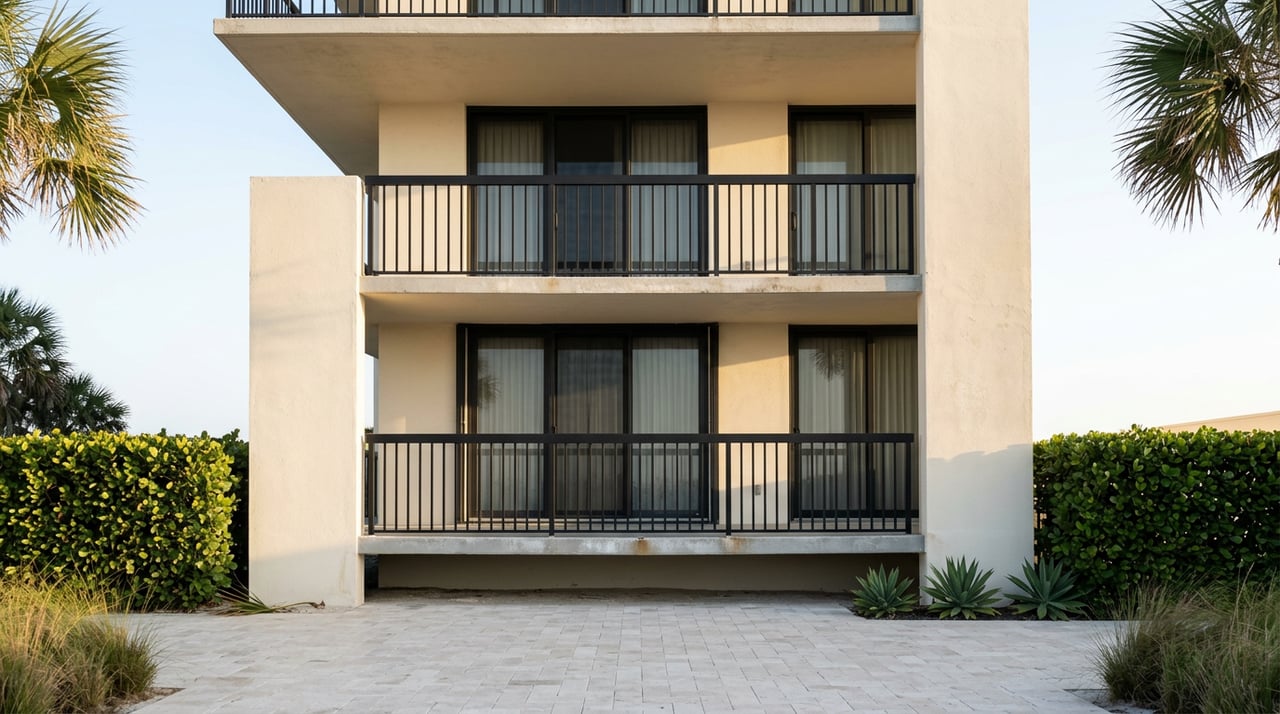
| Oceanfront high-rises along Ponte Vedra Boulevard | Height plus direct salt exposure is exactly what a SIRS is built to evaluate |
| Newer gated mid-rises built after 2010 | Still subject to the SIRS height rule regardless of age, since the mandate triggers on stories, not years |
| South PV gated oceanfront flats (Serenata Beach, Ocean Villas) | Insurance, not structural findings, is often the dominant cost line even in well-maintained buildings |
That last row is worth sitting with. In the Ocean Villas at Serenata segment of South Ponte Vedra Beach, condo dues have been reported around $1,776 a month as of 2026, driven mostly by the master wind and flood policy rather than any structural finding. On a $1.5 million unit in that building, dues alone run past $21,000 a year, and that's before adding property taxes that have ranged from roughly $9,000 to $26,000 depending on assessed value, plus a personal HO-6 walls-in policy on top. None of that is a special assessment. It's simply what insuring an oceanfront structure costs in 2026, and it's a number buyers need before they fall in love with a listing photo, not after.
For sellers: the disclosure package that actually closes deals
Florida Statute 718.503 governs what a condominium seller has to disclose in a resale transaction, and the post-Surfside reforms expanded what a complete package looks like in practice. A resale document set that's missing the current SIRS, the milestone inspection reports, or financials that don't reflect actual reserve contributions isn't just incomplete. It's the kind of gap that slows or kills a financed deal weeks after both sides thought they were done negotiating.
An estoppel certificate under Florida Statute 718.116(8) is capped at $250 for a standard request and $400 for a rush, and the association has a 10-business-day window to deliver it. Sellers who have their SIRS, milestone reports, and two years of financials organized before they list aren't just checking a box. In a market where a buyer's lender is going to ask for every one of those documents anyway, having them ready is what keeps a contract moving instead of stalling in underwriting.
For buyers: ask for the SIRS before you write the offer
The single most common mistake in this market is treating the SIRS and milestone report as due-diligence items to chase down after going under contract. Request them before you write the offer. If the building is required to have a current SIRS and can't produce one, that's material information about where you're about to put your money, not a formality to work out later.
Under Florida's current disclosure framework, buyers get a seven-business-day window after receiving the association's governing documents to review them before the deal becomes binding. Use it. Pull the reserve funding percentage against the SIRS recommendation, check for pending or recently levied special assessments, which nationally have ranged from roughly $10,000 to well over $100,000 per unit in underfunded buildings, and ask your lender to run a warrantability check on the specific project before you get attached to a unit inside it.
Frequently asked questions
Does this apply to single-family homes in Ponte Vedra Beach? No. The SIRS and milestone inspection rules live in Chapter 718, which governs condominiums and cooperatives. Most single-family HOAs fall under a different chapter and aren't directly subject to these structural requirements, though they face their own reserve funding pressures.
Does a brand-new Ponte Vedra Beach condo tower skip all of this? No. The SIRS mandate is triggered by a building's height, not its age, so a project finished in 2026 still needs a SIRS on file, generally within the first year a unit conveys to a non-developer owner. The milestone inspection's age trigger won't apply to a new building for decades, but the reserve study requirement applies from day one.
If a special assessment gets approved while a unit is under contract, who pays it? Florida practice generally treats an assessment approved before closing as the seller's obligation and one approved after closing as the buyer's, but assessments that have been discussed without a formal vote sit in a gray area. Get the timing and responsibility written into the contract rather than assuming either side's default position.
Buying or selling a condo in a market this segmented isn't a job for a generic checklist. If you're weighing a unit in Ponte Vedra Beach and want a straight read on where a specific building stands, Willie Lane Group can walk you through the documents that matter before you write the offer. Schedule Your Consultation and let's look at the paperwork together.